

Mohamed Amin MBE (29 August 1943 – 23 November 1996) was a celebrated Kenyan photojournalist whose work played a pivotal role in chronicling Africa’s history, culture, and social dynamics. Amin’s passion for photography began during his school years, eventually leading to a career defined by his commitment to documenting the continent’s stories. Co-founder of Camerapix, a photography and television production company, Amin became renowned for his vivid coverage of African events, ranging from social challenges and conflicts to moments of historical significance.
One of Amin’s most significant projects is Cradle of Mankind, a photobook and documentary series capturing the rich tapestry of African landscapes, wildlife, peoples, and historical landmarks. This work, enriched by a foreword from renowned Kenyan paleoanthropologist and conservationist Richard Leakey, FRS (1944–2022), underscores Africa’s significance as the birthplace of humanity. Through his lens, Amin sought to present a positive yet realistic portrayal of Africa, showcasing its cultural, historical, and ecological wealth.
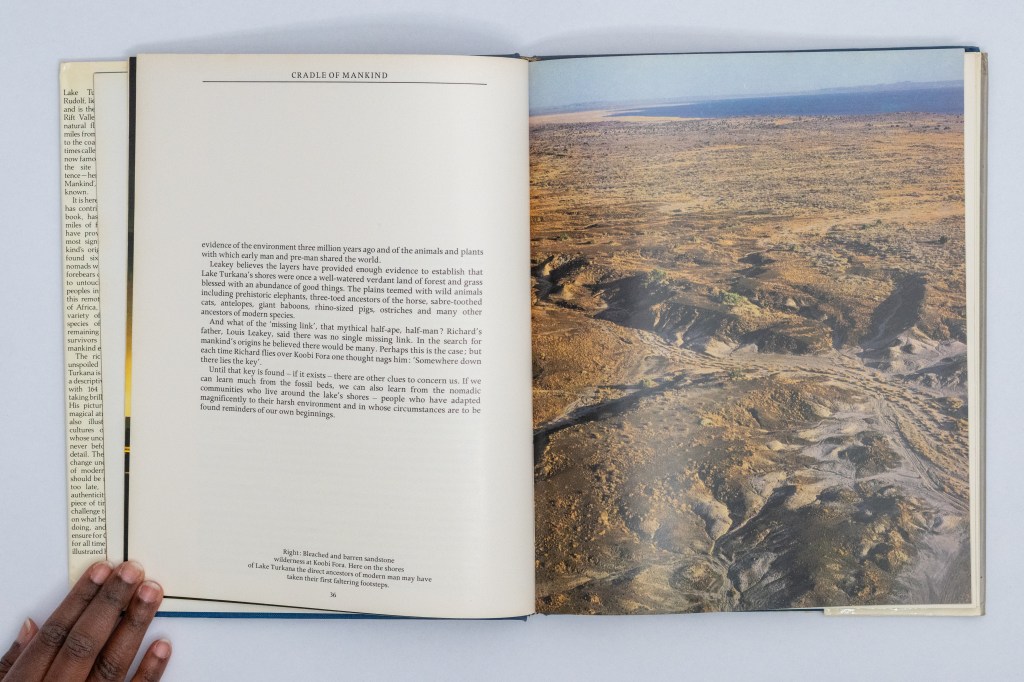
The photobook focuses on the Lake Turkana region in northern Kenya, a place of immense geological, ecological, and cultural significance. Known as the world’s largest permanent desert lake, Lake Turkana is an awe-inspiring expanse of over 6,405 square kilometres, formed by tectonic activity along the Great Rift Valley. Its surroundings feature dramatic volcanic formations, fossil-rich sedimentary layers, and a vibrant ecosystem that supports crocodiles, zebras, antelopes, and diverse fish and bird species.

Amin’s images bring to life the intricate connection between this region and its indigenous communities, including the Turkana, Samburu, Merille, Rendille, and El Molo peoples. Through his photographs, readers are invited to witness their homes, cultural practices, economic activities, and social structures. Key moments such as initiation ceremonies and daily livelihoods like fishing and herding are captured with sensitivity and depth, highlighting the resilience and richness of these communities.

This work also reflects Amin’s dedication to documenting disappearing cultures and landscapes, emphasising the need for preservation. The Lake Turkana region was later designated a UNESCO World Heritage Site in 1997 for its exceptional ecological, geological, and archaeological value.
Amin’s photobook is a sensory and intellectual treasure. The large hardcover features a striking cover photograph of three Turkana tribesmen against the backdrop of Andrew’s volcanic rocks, while the back cover portrays a young El Molo boy holding a crocodile. The musty scent of old books adds a nostalgic charm to this extraordinary publication.

Beyond its aesthetic appeal, Cradle of Mankind represents a shift in the narrative of African photography. Historically, Africa has often been depicted through external perspectives, perpetuating stereotypes and a limited understanding of its people and cultures. Amin’s work challenges this paradigm, offering an authentic and nuanced representation of Africa’s diversity, creativity, and resilience.
His photobook underscores the importance of self-representation for African photographers, who possess a unique and intimate understanding of their continent. By telling their own stories, they reclaim narratives, preserve cultural knowledge, and counter external misconceptions. Amin’s work exemplifies the power of photography to document and protect cultural heritage while inspiring pride, fostering identity, and promoting understanding.

African photographers play a critical role in challenging one-dimensional portrayals that focus narrowly on poverty, conflict, or hardship. Instead, they showcase the continent’s innovation, beauty, and contributions to the global community. Photography can also serve as a tool for social advocacy, raising awareness about issues such as inequality, environmental challenges, and gender dynamics, ultimately driving positive change.

In conclusion, Mohamed Amin’s Cradle of Mankind is not merely a photobook—it is a profound testament to Africa’s heritage and humanity’s shared origins. Amin’s dedication to his craft and his visionary storytelling continue to inspire generations, reminding us of the transformative power of authentic representation.

 The African Photobook
Leave a comment